Historically grounded analysis for complex institutional and policy environments.
For clients navigating complex institutional or policy environments, HRS provides historically grounded analysis designed to clarify long-term structural considerations and support informed decision-making.
Historical context and institutional analysis for large-scale infrastructure and environmental planning projects. Identifying precedent, institutional patterns, and policy frameworks that inform current decision-making.
Historically informed policy research that contextualizes current regulatory and legislative questions within their institutional and political origins. Supporting agencies and advisory bodies seeking depth beyond surface-level analysis.
Analytical assessments of institutional structures, governance histories, and organizational patterns. Historically grounded evaluations clarifying how current systems emerged and where structural considerations may affect future decisions.
Concise, well-researched briefing documents synthesizing complex historical and institutional information for decision-makers. Designed for clarity and utility in professional and policy settings.
Analysis Example
Bayesian analysis of 582 archival documents from the Gracie Pfost Papers, 1958–1964
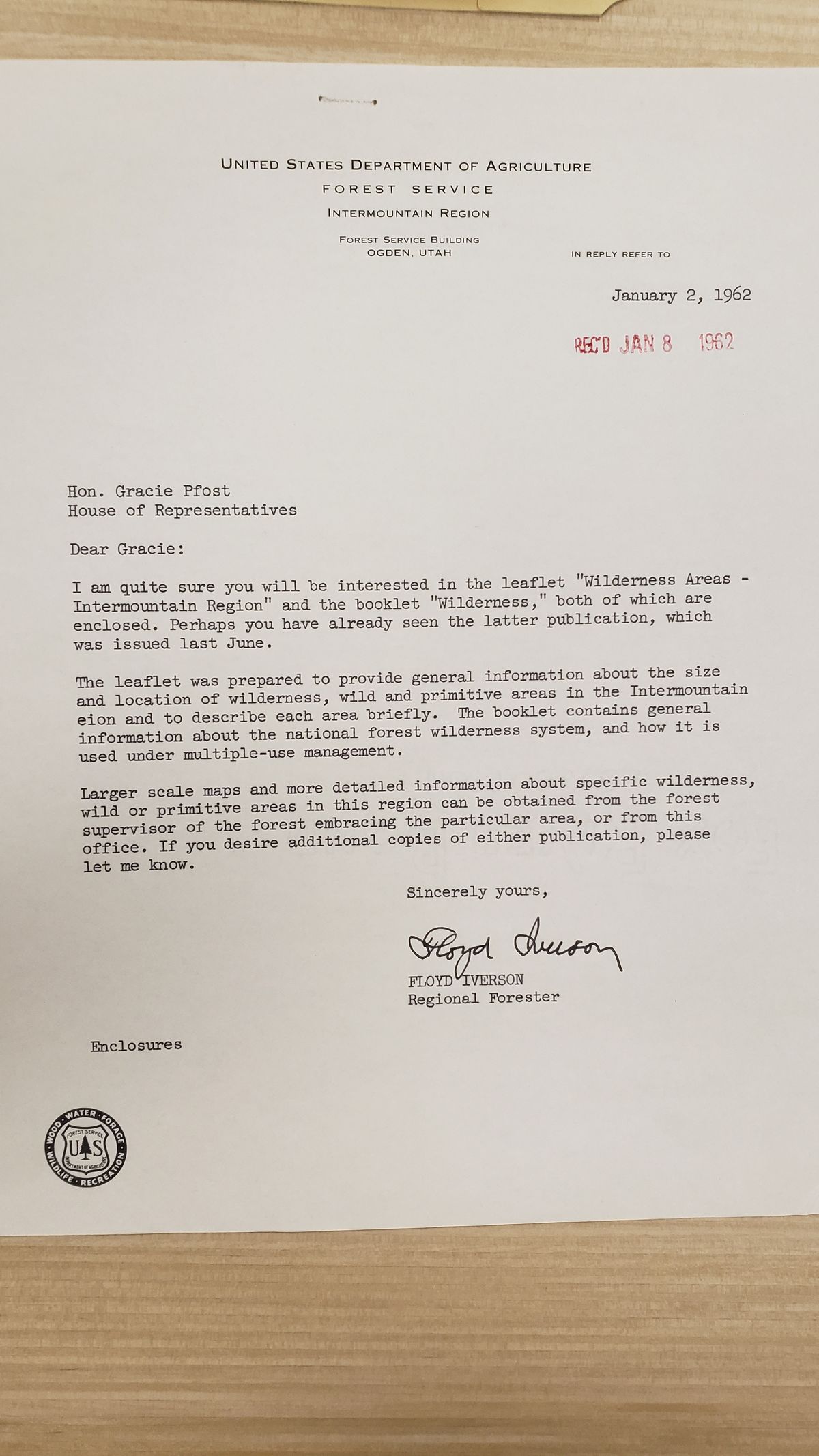
The Wilderness Act of 1964 is often told as a national conservation story, but in Idaho it was a live political contest over public land governance. Congresswoman Gracie Pfost’s papers — held at the University of Idaho Library Special Collections — preserve the letters, memoranda, hearing testimony, and agency correspondence that document how Idaho constituents, industry groups, and federal officials engaged the bill across six years of legislative activity.
This project used computational historical methods to analyze 582 documents from that archive. Bayesian topic modeling, named entity extraction, automated position classification, and changepoint detection were applied to surface structural patterns in the correspondence — who wrote, when, from what position, and around which themes — that would be difficult to identify through close reading alone. The result is a quantitative complement to traditional archival interpretation, revealing how organized opposition concentrated at procedural inflection points while broad citizen support remained more diffuse.
The most common entities in the corpus include Gracie Pfost, Idaho, S. 174, the Public Lands Subcommittee, and the Forest Service — indicating that constituents tracked the bill through concrete institutions and specific representatives rather than discussing conservation in symbolic terms.
Supportive correspondence emphasized preservation, future generations, and keeping exceptional lands intact. Opposing letters focused on employment, mining, timber access, and the fear that federal policy would lock away resources needed for Idaho communities.
Industry organizations were twice as likely to oppose as support. Opposition was most concentrated during hearing activity — particularly March 1961, when 69% of correspondence opposed the bill — while broad citizen support was more evenly distributed over time.
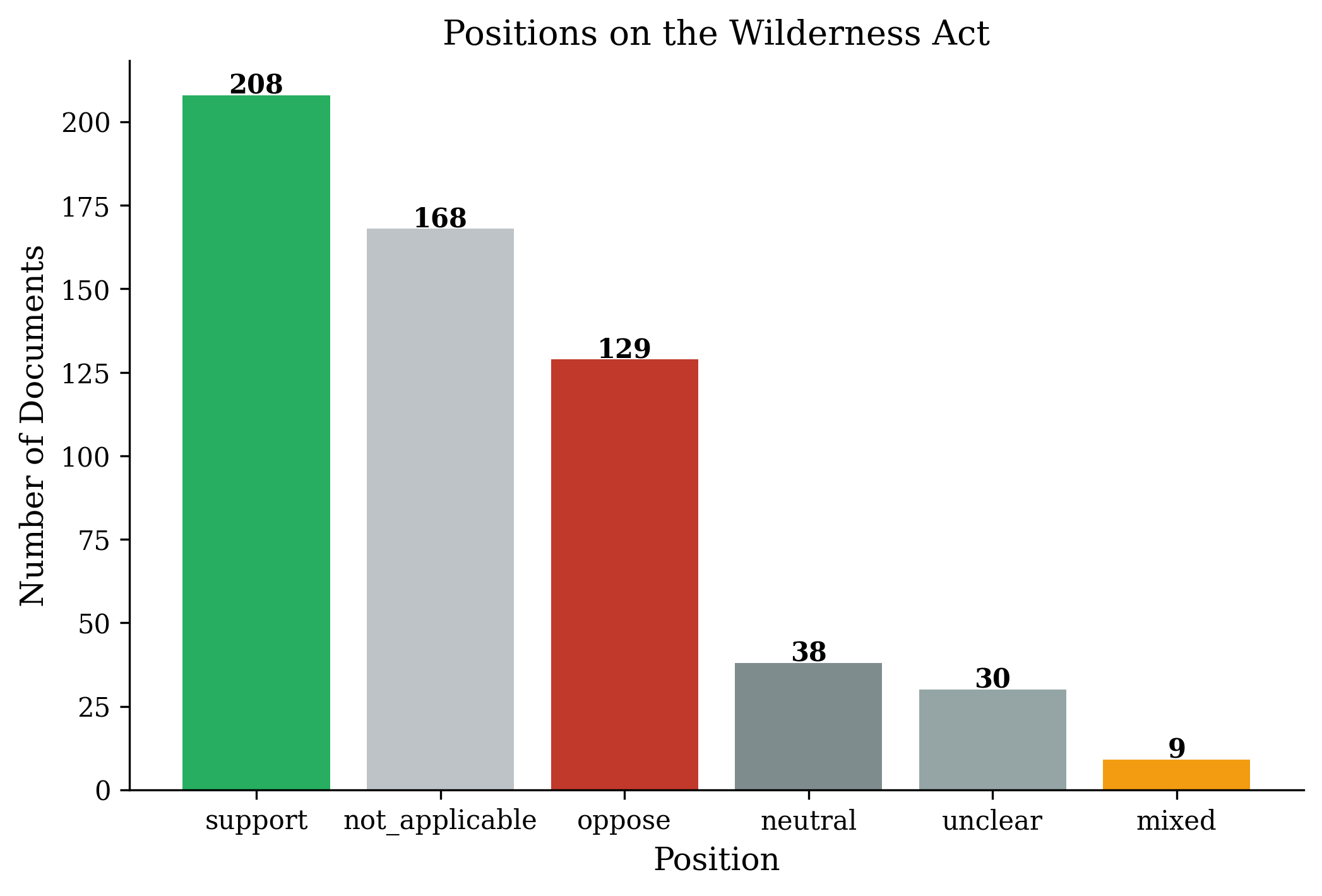
Position distribution across the 582-document corpus. Among position-taking documents, support exceeds opposition overall.
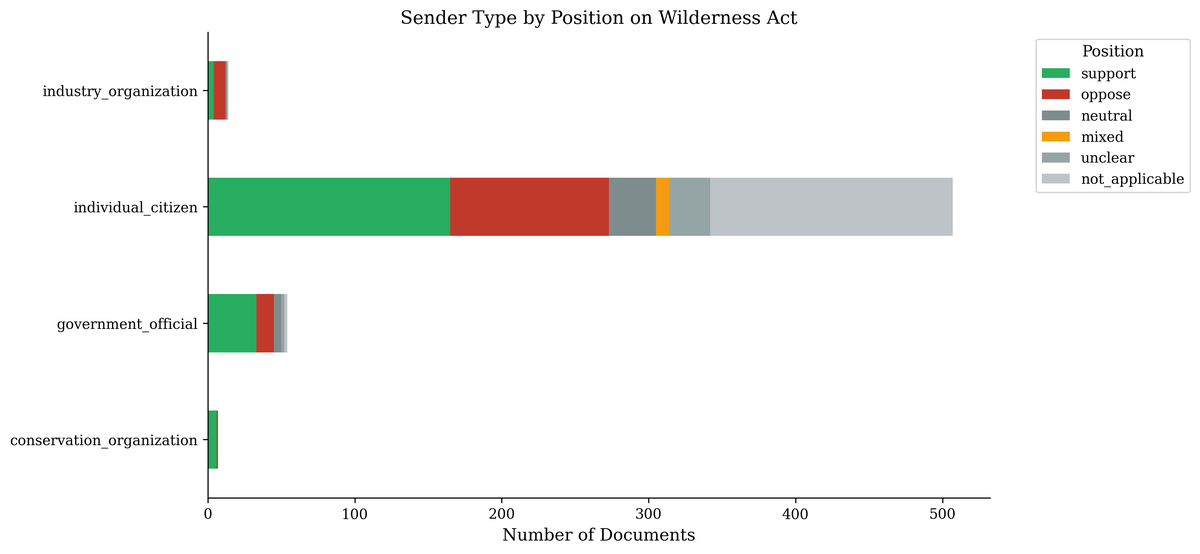
Sender type by position. Individual citizens drove overall participation, while industry organizations disproportionately clustered in opposition.
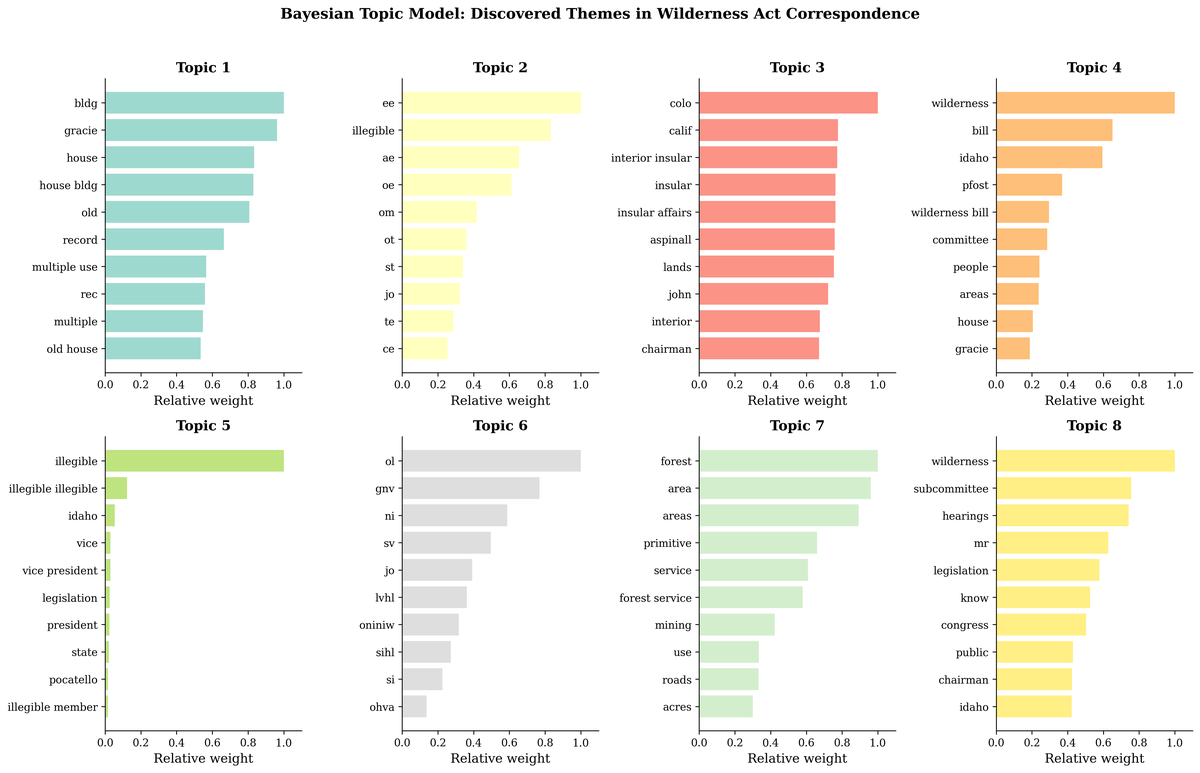
Bayesian topic model revealing eight thematic clusters across the correspondence, from legislative procedure to resource-use framing.
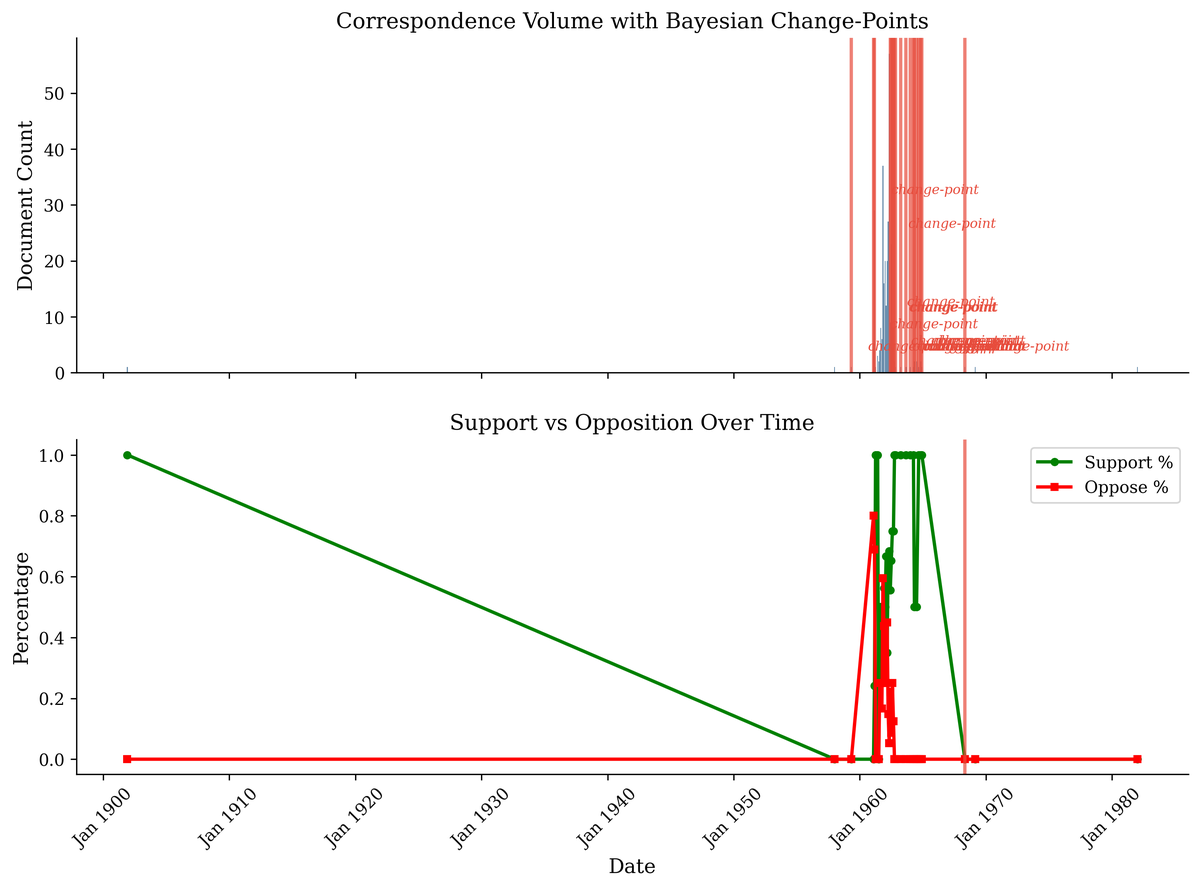
Bayesian changepoint detection identifying structural shifts in correspondence volume and the balance of support versus opposition over time.
OCR-transcribed archival correspondence analyzed with Bayesian topic modeling, named entity extraction, automated correspondence classification, and changepoint detection. The goal was not to replace close reading but to identify large-scale patterns across the corpus that would be invisible to traditional methods alone.
Source: Gracie Pfost Papers, Boxes 10 and 48, University of Idaho Library Special Collections and Archives.
We work with agencies, organizations, and advisory bodies on complex institutional questions.
Contact HRS